
What Is Regenerative Agriculture?
What if growing food didn’t begin with disturbing the soil? For many people, gardening begins with digging. They turn the soil, remove what is considered unwanted, plant the crops, protect them from everything that might eat them, harvest what they need, and repeat the following year, from the beginning.
Regenerative agriculture asks us to look at this relationship differently. Regenerative agriculture is an approach to growing food that aims to restore soil health, support biodiversity and work with natural ecological processes rather than against them.
Rather than treating soil simply as a medium in which plants grow, regenerative approaches see it as a living ecosystem, one shaped by microorganisms, fungi, insects, organic matter, water, plant roots and countless relationships happening beneath our feet.
There is no single universal recipe for regenerative agriculture. But its principles generally point in the same direction:
- disturb the soil as little as possible,
- keep it covered,
- maintain living roots and biodiversity,
- recycle organic matter,
- conserve water and
- work with natural processes rather than constantly trying to control them.
At GEA, we are still learning what this means on our own piece of land. And we decided to practise it seasonally. Perhaps that is exactly the point.
How We Practice Regenerative Agriculture at GEA Retreat
One of the most visible differences in our garden is what we don’t do.
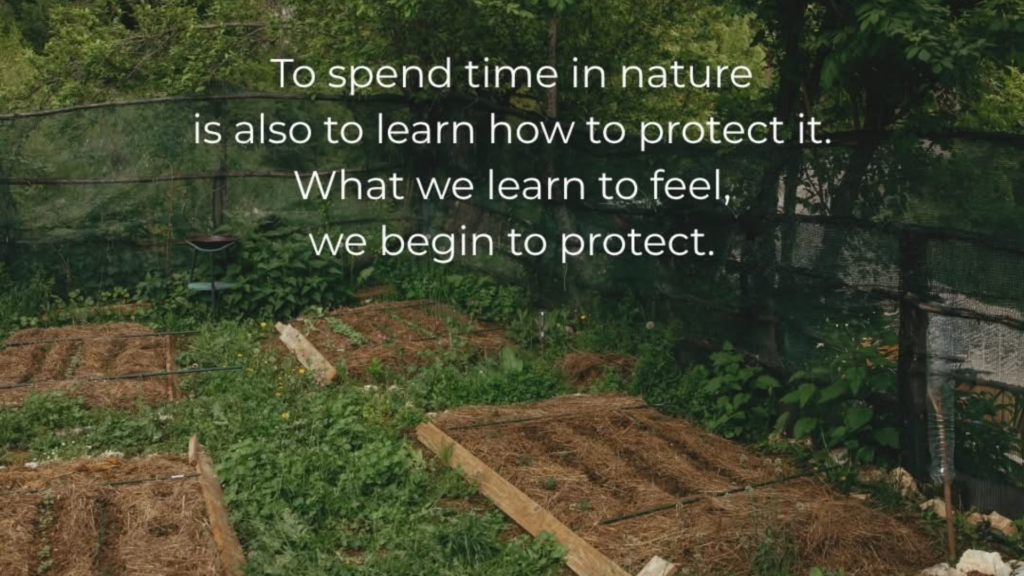
We don’t begin every growing season by digging and turning over the land. Instead, we create growing areas using hay and compost, building layers of organic material above the existing soil. Small planting nests or canals allow us to plant into this protected environment while leaving much of the soil beneath mostly undisturbed.
The hay helps cover the ground, retain moisture and gradually return organic matter to the soil as it decomposes. This way of growing also changes the way we think about the garden itself. It is not something that begins when we plant in spring and disappears after the final harvest. The garden is never really finished. One season gradually creates the conditions for another.
How We Protect Plants Naturally: Our Preventive Approach
Regenerative gardening does not mean simply planting something and hoping nature will take care of the rest. Observation is a large part of the work. Rather than waiting until plants are heavily affected by insects or disease, at GEA we use a variety of homemade botanical preparations as part of our preventive garden-care routine.
Our garden shelf changes throughout the season: preparations made with bay leaves, horsetail, cinnamon, cloves, dandelion leaves, ivy leaves and other plants all find their way into our gardening practice. Some come from traditional gardening knowledge, some from natural and organic growing practices, and all are part of an approach in which we try to intervene gently and observe how our particular garden responds.
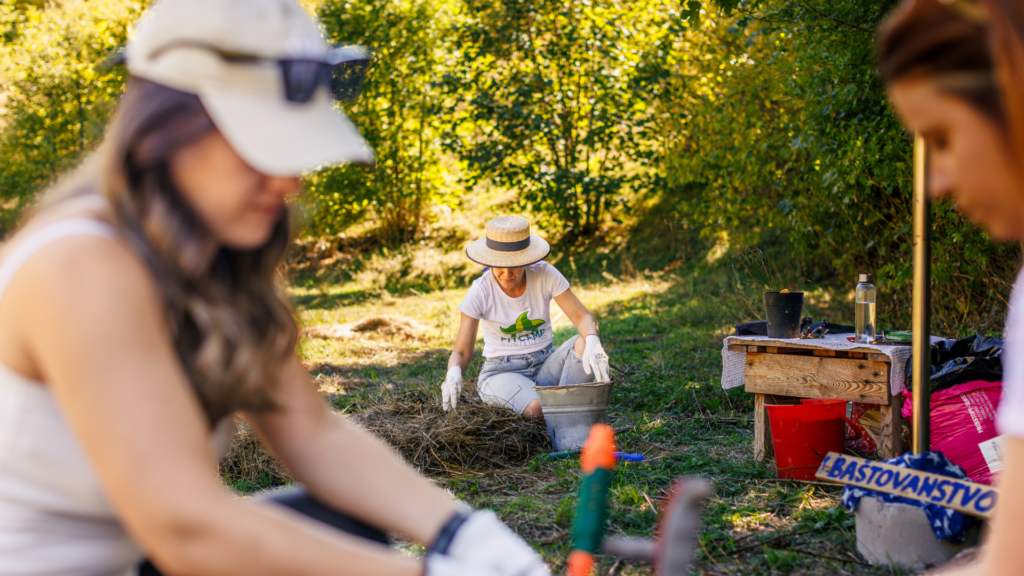
We won’t give away all our recipes here. But guests who garden with us at GEA can discover some of them as part of the experience, because we believe certain knowledge is best shared with dirty hands, a watering can nearby and an actual plant in front of you and all the wisdom coming from the experience itself should definitely be shared and spread as far as possible.
Composting, Soil Regeneration & Rainwater
Nothing really leaves the garden. When a plant finishes producing for the season, its story does not necessarily end. Where appropriate, healthy plant material is composted and returned to the same growing systems. Slowly, it becomes part of the organic matter that will support future crops. Yesterday’s garden becomes tomorrow’s soil.
Water belongs to this cycle, too. We irrigate our garden with rainwater collected at GEA, another way of working with what the landscape naturally provides.
What Is Mindful Gardening?
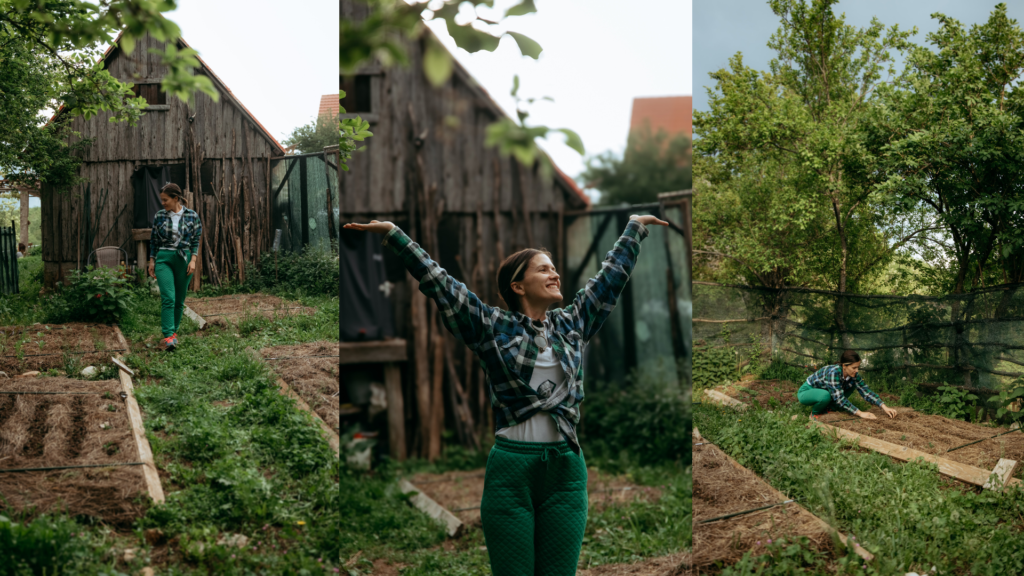
Mindful gardening combines the practice of growing and caring for plants with intentional attention to the present moment. For us at GEA, this means that gardening is not simply another task that needs to be completed. It can be an opportunity to slow down, observe, touch the soil, ground ourselves, notice changes, accept uncertainty and become more aware of our own reactions to what happens in front of us. Gardening is also an opportunity to practise mindfulness.
We wish to share the seven principles (or better say attitudes) associated with mindful gardening (inspired by Ann Swanson’s book “Meditation for the Real World”).
- Non-judging – Not every crooked leaf means something is wrong. Observe before deciding that something needs fixing.
- Patience – A seed cannot be rushed. Neither can every process in our own lives.
- Beginner’s mind – Even if you have grown tomatoes twenty times, this soil, this summer, and this particular plant have never existed before.
- Trust – Learn to trust observation, experience and natural processes, including those happening where you cannot see them.
- Non-striving – A garden constantly reminds us that effort does not equal control. We can create conditions for growth; we cannot command it.
- Acceptance – Weather changes. Seeds fail. Insects arrive. Some plants thrive, and others don’t. Acceptance does not mean doing nothing. It means seeing clearly what is actually happening before deciding how to respond.
Join us at Soil & Soul: Acceptance, our signature one-day retreat to understand this topic on a deeper level.
- Letting go – Eventually, every season ends. Plants that fed us dry, decompose and return to the soil. Making room for what comes next is part of the cycle.
Regenerative Gardening as a Way of Living
Grow food. Grow soil. Grow awareness. Regenerative agriculture asks a different question from conventional growing.
Not only:
What can we take from this land?
But also:
What will be left here because we cared for it?
That is the question we are learning to garden with. Our methods will evolve. Some experiments will work beautifully. Others won’t. The garden will keep teaching us. That is what mindful bio-gardening means to us: not trying to dominate nature, but learning how to participate in it.
Join us in exploring our true selves with the help of our Mother Earth.