Table of Contents
How ancient yoga philosophy inspires our approach to naturopathy, mindful eating, nature and holistic wellbeing at GEA Retreat.
For many people, yoga begins with a mat, a series of physical postures and perhaps a few moments of relaxation at the end of a class. But yoga has a much deeper philosophical foundation. In the classical yoga tradition described in Patañjali’s Yoga Sutras, physical postures (known as asanas) represent only one of eight interconnected limbs. Together, these limbs offer a framework for ethical living, self-discipline, physical practice, breath regulation, attention, meditation and deeper states of awareness.
In this understanding, yoga is not simply about what the body can do.
It is also about how we choose to live. At GEA Retreat, this philosophy resonates with something we explore every day: the relationship between our habits, our wellbeing, the natural world and the way we experience life.
What Are the Eight Limbs of Yoga?
The eight limbs of yoga, known as Ashtanga, are presented in Patañjali’s Yoga Sutras as interconnected aspects of the yogic path. Although they are often introduced as a sequence, they are not simply eight exercises to complete or eight achievements to collect. Each offers a different dimension of practice. Let’s explore them a bit.
1. Yama or How We Relate to the World
Yama refers to ethical principles that guide our behaviour toward others.
These include ahimsa (non-harming), satya (truthfulness), asteya (non-stealing), brahmacharya (wise restraint) and aparigraha (non-grasping).
At GEA, these principles invite us to reflect on our relationship with the environment, animals, the local community and the resources we use.
- Can we consume more consciously?
- Can we reduce unnecessary harm?
- Can we learn to take only what we need?
A yoga practice may begin with the way we treat the world around us.
2. Niyama or How We Relate to Ourselves
Niyama concerns personal observances and inner discipline. Its five principles are saucha (cleanliness), santosha (contentment), tapas (disciplined effort), svadhyaya (self-study) and ishvara pranidhana (devotion or surrender to a higher principle).
They invite us to observe our habits, motivations and relationship with ourselves. At GEA, this connects naturally with our interest in conscious lifestyle choices. Not through the pursuit of a perfect routine, but through the willingness to understand ourselves a little better.
3. Asana or The Practice of Physical Postures
Asana is the aspect of yoga most familiar to modern practitioners. Yet in the classical Yoga Sutras, the emphasis is on steadiness and ease in posture, rather than physical complexity or performance.
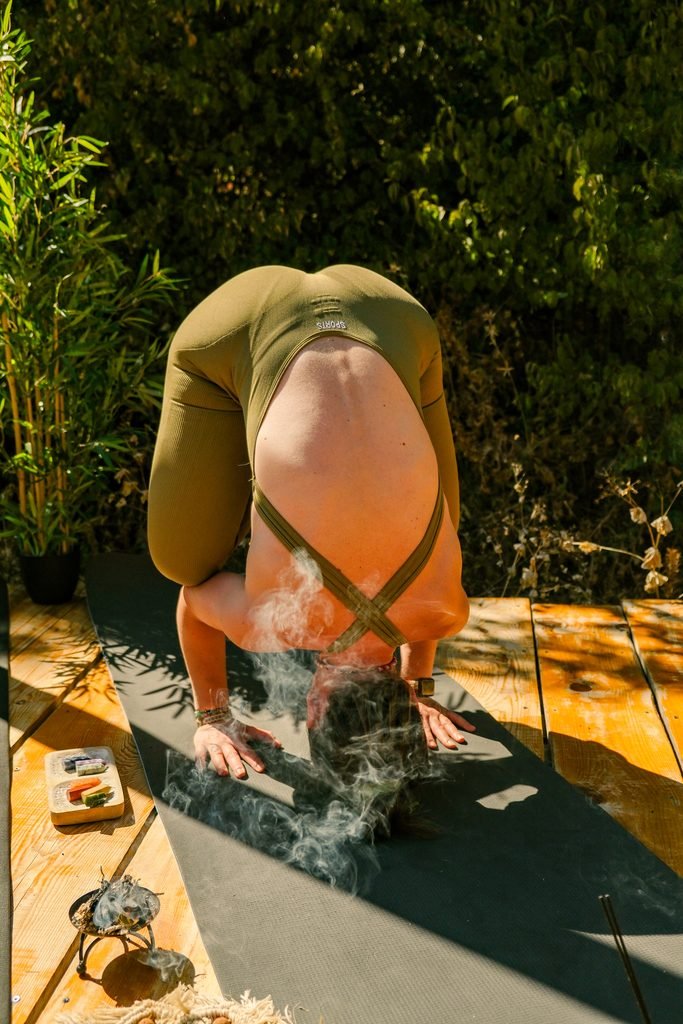
Practising yoga in nature can offer a beautiful opportunity to explore movement, balance, physical awareness and the relationship between body and environment. The goal is not necessarily to master a more difficult pose. Sometimes, it is simply to notice how we feel while practising.
4. Pranayama or Working With the Breath
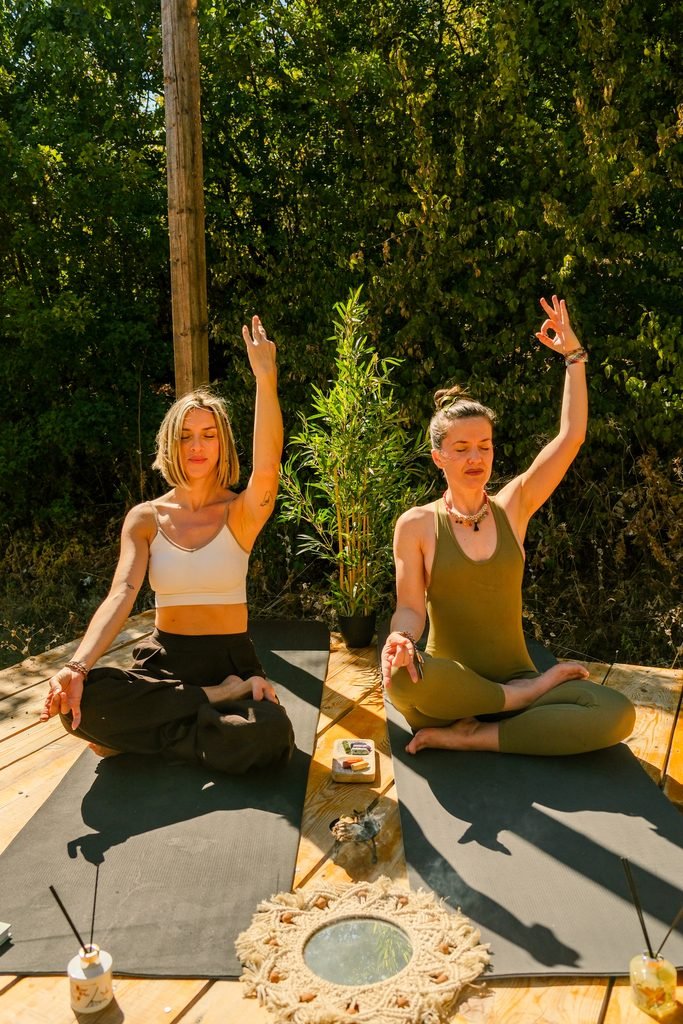
Pranayama involves the intentional regulation of breathing. Breath is closely connected with our physical and emotional state, and gentle breathing practices can support relaxation and attention.
At GEA, conscious breathing is one of the simplest ways to begin slowing down. Before a yoga session. During meditation. During a mindful eating session. During Reiki. Or while sitting quietly beneath a tree. Sometimes, awareness begins with something we have been doing our entire lives without thinking about it.
5. Pratyahara or Turning Attention Inward
Pratyahara is traditionally described as the withdrawal of the senses from their external objects. It is not simply about escaping noise or avoiding technology. It concerns our relationship with sensory experience and our ability to turn attention inward.
Still, modern life offers an interesting parallel. We are constantly responding to notifications, information, sounds and demands on our attention. At GEA, moments of quiet, digital disconnection and time in nature can create opportunities to notice how strongly we are pulled toward external stimulation.
Question yourself – What happens when we no longer feel the need to respond to everything? Can you do it?
6. Dharana or The Practice of Concentration
Dharana refers to holding attention steadily on a chosen point or object.
It is the practice of concentration. And while mindful eating or gardening are not themselves classical Dharana practices, they can help us explore a related skill: intentional attention.
Consider the difference between eating while scrolling through your phone and eating while truly noticing the food in front of you. Or between rushing through garden tasks and pausing to observe a seedling, the soil around its roots or the movement of an insect.
One breath. One bite. >> One seed. One moment.
Attention changes the quality of an experience.
7. Dhyana or Meditation
Dhyana refers to sustained meditation, where attention becomes more continuous and less interrupted. Meditation invites us to develop a different relationship with thoughts and mental activity. It is not necessarily about eliminating thoughts or achieving permanent calm.
At GEA, opportunities for quiet reflection are woven into different experiences, from meditation sessions to moments of stillness in the forest. The natural environment does not automatically create a meditative state. But it can provide a setting in which we choose to practise being present. One of our lovely moments of mindful meditation is done through forest bathing or ecstatic dance.
8. Samadhi or Meditative Absorption
Samadhi is traditionally understood as a profound state of meditative absorption. It is one of the most significant concepts in classical yoga philosophy and cannot be reduced to simply feeling peaceful, relaxed or connected with nature.
At GEA, we do not claim to teach or produce such states through our retreat experiences. Instead, this final limb reminds us that yoga has philosophical and contemplative depths far beyond the physical practices with which many of us first encounter it.

Eight Limbs, One Way of Living: What Can Yoga Teach Us About Everyday Life?
What makes the eight limbs particularly interesting is that their relevance does not have to end when we leave a yoga class. Ethical choices influence how we consume and interact with the world. Self-observation influences our habits. Physical practice encourages body awareness. Breathing and attention invite us to slow down. Meditation encourages a more conscious relationship with our thoughts.
These are not separate compartments of life. They influence one another, and this is where the philosophy of yoga begins to resonate with our wider approach to wellbeing at GEA.
A garden, for example, can invite patience and non-harming. A shared meal can invite gratitude and attention. A walk through the forest can create space for reflection.
These activities do not become yoga simply because we practise them mindfully. But the attitudes cultivated through yoga can influence how we experience them.
How Do Yoga and Naturopathy Complement Each Other?
Yoga and naturopathy have different histories, methods and philosophical foundations. However, they can complement one another in a lifestyle-oriented approach to wellbeing.
Naturopathy, as we practise it at GEA, encourages us to look at the person as a whole and support our wellbeing preventively. Yoga introduces additional dimensions of self-observation.
- How do we sleep?
- What do we eat?
- How do we move?
- How do we respond to stress?
- What role does our environment play in our everyday habits?
- How do we relate to our bodies?
- How do we direct our attention?
- How do we respond when things do not go according to plan?
Where naturopathy may help us examine the conditions surrounding our wellbeing, yoga can invite us to explore our relationship with those conditions. Neither approach replaces appropriate medical care, and neither requires us to pursue a perfect lifestyle. For us, their connection lies in awareness, prevention-oriented habits and a more intentional relationship with everyday living.
How GEA’s Philosophy with Mindful Eating, Reiki and Nature-Based Practices Fit Into the Classical Yoga Concept
At first glance, yoga, mindful eating, Reiki, forest bathing and regenerative gardening may appear to be a collection of unrelated wellness activities. And in terms of their origins and methods, they are different. Yet each can offer a distinct opportunity to slow down and reflect.
- Mindful eating encourages attention to hunger, flavour, texture, satisfaction and our relationship with food.
- Regenerative gardening invites us to observe natural cycles, practise patience and reconsider our relationship with the land.
- Forest bathing encourages intentional sensory engagement with the forest, without the pressure to reach a destination or achieve a particular outcome.
- Meditation offers structured opportunities to practise attention and awareness.
- Reiki, a Japanese complementary practice, is offered at GEA as a personal experience of rest and relaxation. Its proposed energy-healing mechanisms are not scientifically established, and it should not be presented as a substitute for healthcare.
- And yoga provides a rich philosophical tradition through which we can reflect on ethics, discipline, awareness and contemplative practice.
What connects them at GEA is an intention to create more space for conscious living.
Why Conscious Living Matters at GEA Retreat
We live in a time when wellbeing is often presented as something we need to acquire. Another supplement, routine, device… Another method promising to improve us.
Some tools can be useful, of course. But perhaps wellbeing also deserves a different question. What if, instead of constantly adding something new, we paid more attention to what is already happening in our lives?
To how we eat. How we rest. How we move. How we treat ourselves, other people and the natural environment.
We are creating a space where different practices can be explored with curiosity, respect and awareness, where nature is not merely a background for activities, but an environment we learn to observe, appreciate and care for.
Take a look at our dedicated Mindful Yoga Getaway here, which gives you the chance to fully personalise your experience with us, and it’s perfect if you are travelling solo or as a couple.